RegWatch
Reads the entire Federal Register every night and surfaces the handful of rules that actually reach one company — with every claim anchored to the exact characters it came from.
- Python
- FastAPI
- SQLite
- Anthropic
- OpenRouter
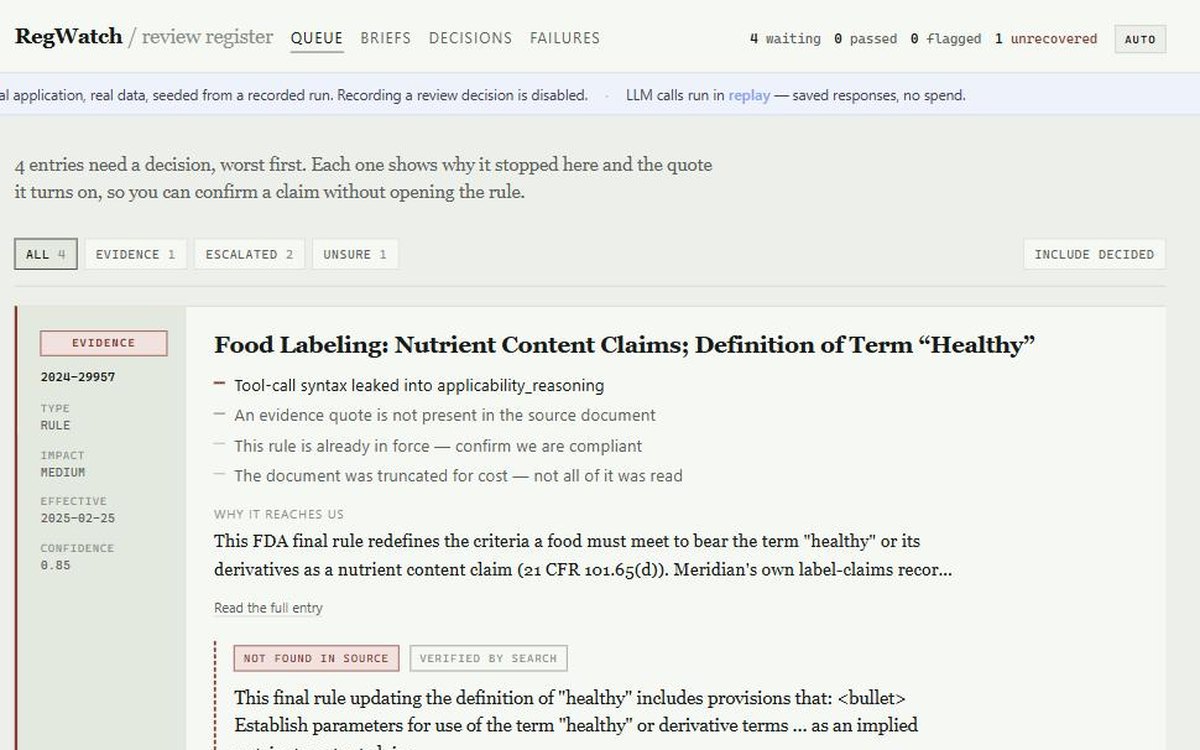
A compliance analyst at a mid-size food manufacturer spends about three hours every morning reading the Federal Register to find the roughly forty rules a year that touch their facilities. That is 725 hours a year spent, almost entirely, confirming that nothing happened.
RegWatch does the first pass. It pulls everything published, triages it with a cheap model, assesses what survives against a specific company profile with a stronger one, and produces a brief where every statement is tied back to the characters in the source document it came from. Anything high-impact or uncertain is escalated to a person rather than decided.
The part worth looking at
Dates cannot be hallucinated, because the model is never asked for one.
effective_on has no field in the submission schema — it is filled
deterministically from the Federal Register API after the model has had its
say. A wrong effective date is the one error in this domain that is both easy
for a language model to make and expensive to discover late, so it was designed
out of the interface rather than checked for afterwards.
The same instinct runs through the rest: a claim without a locatable quote does not make the brief, passes are logged as carefully as flags (a system that records only problems cannot tell you its own false-positive rate), and the dashboard shows the evidence rather than a summary of the evidence.
Measured cost of a live run: $1.43/day.